
Two simple exercises to improve your balance, build confidence, and help you stay steady on your feet.
Have you ever watched a police officer ask someone to walk heel-to-toe during a roadside sobriety test?
There’s a reason for that. Walking with one foot directly in front of the other challenges your balance.
But you don’t need flashing lights or a police officer to try it.
This week’s exercise is actually two related movements: tandem stance and tandem walking.
They’re simple, require no special equipment, and can help improve your balance when practiced safely.
Why I like these exercises
As we get older, our balance may become less reliable.
Our muscles can weaken, our reaction times may slow, and the signals traveling between our feet and brain may become less accurate.
Tandem exercises challenge several of these systems at once.
When you stand with your feet side by side, you have a relatively wide base of support.
Place one foot directly in front of the other, and that base becomes much narrower.
Now your brain, muscles, eyes, and inner ears must work together to keep you upright.
Tandem stance trains your ability to remain steady while standing still.
Tandem walking adds movement, requiring you to shift your weight from one leg to the other while maintaining control.
Both skills matter when you’re walking on uneven ground, turning, or moving through crowded spaces.
And here’s the best part: You can practice them right in your kitchen.
How to do it
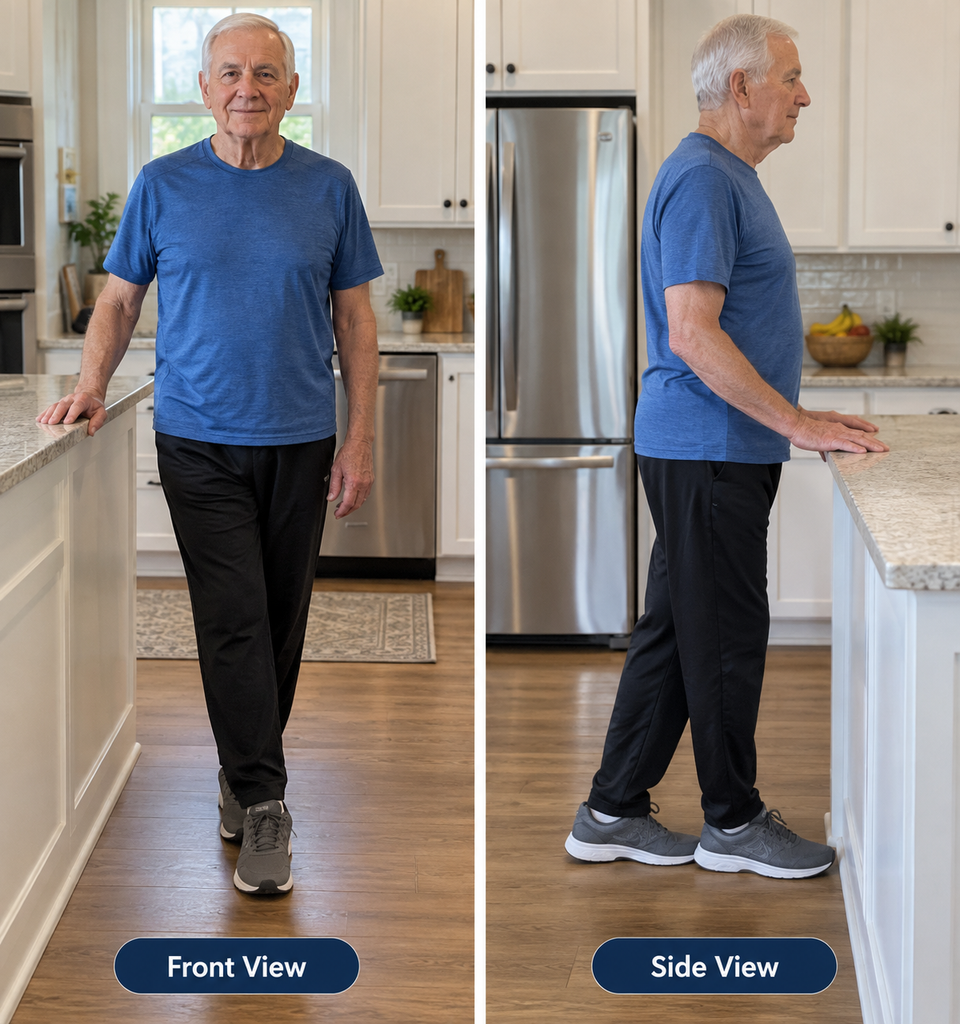
Part 1
Tandem stance
- Stand beside a sturdy kitchen counter, holding it with both hands or using a secure support arrangement.
- Place one foot directly in front of the other, with the heel of your front foot near the toes of your back foot.
- Stand tall and look straight ahead.
- Hold the position for 10–20 seconds.
- Switch which foot is in front and repeat.
Keep your knees slightly relaxed. Breathe normally.

Part 2
Tandem walking
- Stand beside a long, sturdy counter or securely fixed railing.
- Place one foot directly in front of the other.
- Take a slow step forward, bringing your heel close to the toes of your opposite foot.
- Continue for 5–10 steps while keeping support within reach.
- Stop, turn safely using normal steps, and repeat.
Focus on smooth, controlled movement rather than speed.
The biggest mistake
Trying to make the exercise too difficult too soon.
I don’t recommend starting with your eyes closed or attempting tandem walking without something sturdy to hold.
Those changes increase the challenge, but they also increase your risk of falling.
Start with support and gradually progress as your balance improves.
Remember, the goal is to prevent falls, not practice them!
Easier and harder options
Make it easier
Try a semi-tandem stance. Place one foot slightly ahead of the other, but keep your feet separated from side to side.
For walking, leave a small gap between your feet rather than placing them directly in line.
Make it harder
Gradually increase your standing time to 30 seconds.
If you can do this safely, use lighter hand support while keeping the counter within immediate reach.
Don’t progress to unsupported walking if you’re unsteady.
Dr. Mike’s Prescription
Your weekly balance plan
| Exercise | Starting dose |
|---|---|
| Tandem stance | 2–3 holds of 10–20 seconds, each foot forward |
| Tandem walking | 2–3 passes of 5–10 steps |
| Frequency | 3–5 days per week |
Practice beside a sturdy support. If you’ve recently fallen or cannot safely hold the position, ask a physical therapist for guidance before starting.
My advice: Make balance training a regular part of your exercise routine, just like strength training and cardio.
The bottom line
You don’t have to accept declining balance as an unavoidable part of aging.
With safe, regular practice, many people can improve their steadiness and confidence.
Start slowly, keep your support nearby, and give yourself time to improve.
Your goal isn’t to walk a perfect straight line.
It’s to keep walking confidently through life.