
WHAT TO KNOW AFTER 50
You probably think about your heart.
Maybe you worry about your brain, your bones, your muscles, or even your waistline.
But when was the last time you thought about your kidneys? For most people, the answer is: almost never.
That is partly because your kidneys are remarkably quiet organs. They don’t usually complain. They don’t ache when they are beginning to lose function. And you can lose a surprising amount of kidney function without feeling any different.
Yet your kidneys are working for you 24 hours a day, seven days a week.
And just like the rest of your body, they age too.

In Today’s Exercise Doc
Here’s what we’ll cover:
- What your kidneys actually do
- How kidney function changes as you get older
- Why high blood pressure and diabetes matter so much
- The medications that deserve a little extra attention
- What those kidney numbers on your blood work actually mean
- What you can do now to protect your kidneys
Your Kidneys Are Much More Than Filters
Most of us learned somewhere along the way that the kidneys “filter the blood.” That’s true. But it’s a little like saying your smartphone makes phone calls. Yes, it does—but there’s a lot more going on.
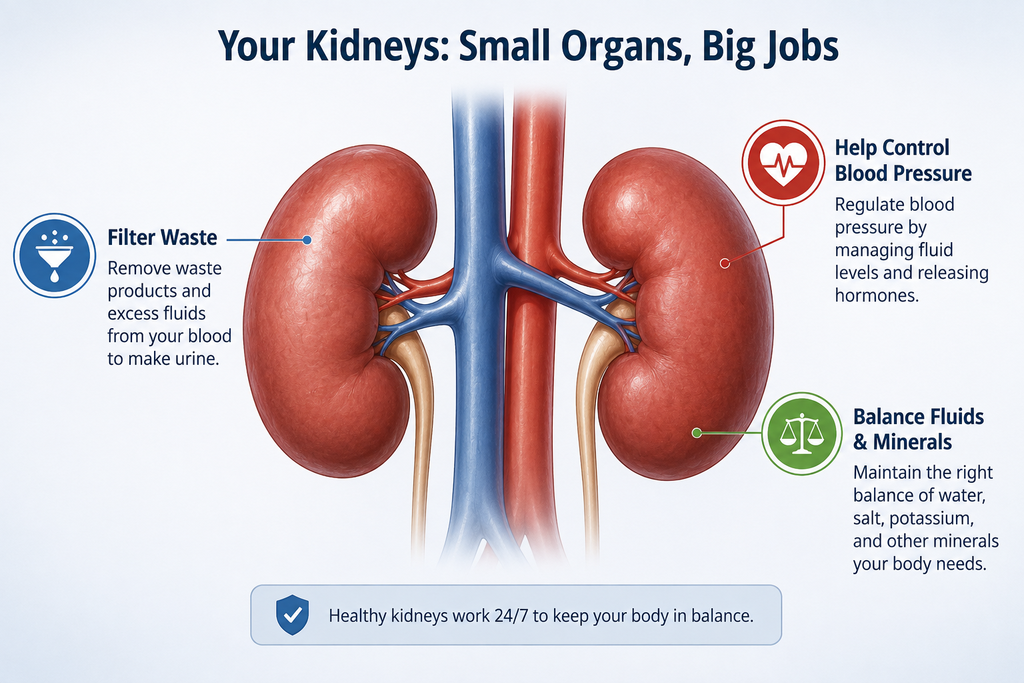
Your two kidneys filter waste products and excess water from your blood, which eventually become urine.
But they also help:
- Control your body’s fluid balance
- Maintain the right levels of sodium, potassium, and other minerals
- Regulate blood pressure
- Maintain the body’s acid-base balance
- Stimulate production of red blood cells
- Activate vitamin D, which is important for your bones
They’re pretty impressive little organs.
And here’s the interesting part: They do all of this without you noticing.
Until something goes wrong.
What Happens to Your Kidneys as You Age?
Kidney function tends to gradually decline with age.
Blood flow to the kidneys may decrease. Some of the tiny filtering structures inside the kidneys can become less efficient. The kidneys may also become less able to handle sudden changes in hydration, blood pressure, medications, or illness.
That doesn’t mean everyone eventually develops kidney failure. Far from it.
Many people maintain adequate kidney function throughout their lives.
But it does mean that the margin for error may become smaller as we get older.
Imagine you had a pickup truck when you were 25 that could haul 2,000 pounds without complaining.
Forty years later, the truck still runs pretty well. But you might think twice before loading 2,000 pounds into the back and driving through the mountains.
Your kidneys can be a little like that.
They may still work very well, but they may not tolerate stress quite as easily as they once did.
Dr. Mike’s Take
Getting older does not automatically mean developing kidney disease. But aging makes protecting the kidney function you have increasingly important.
The Two Big Kidney Enemies
If I asked you what causes kidney disease, you might guess toxins, medications, or infections.
Those certainly can cause problems.
But two very common conditions account for a huge portion of chronic kidney disease:
Diabetes and high blood pressure.
High blood sugar over many years can damage the tiny blood vessels and filtering structures inside the kidneys.
High blood pressure can do something similar.
And there is an unfortunate feedback loop.
High blood pressure can damage the kidneys—and damaged kidneys can make blood pressure more difficult to control.
This is one reason I keep coming back to blood pressure.
You may feel perfectly fine with a blood pressure of 160/90. Your kidneys don’t necessarily feel fine about it.
Kidney Disease Can Be Surprisingly Quiet
One of the biggest problems with chronic kidney disease is that early disease may cause no obvious symptoms at all.
You can feel completely normal.
By the time symptoms such as significant swelling, nausea, weakness, itching, appetite changes, or shortness of breath develop, kidney disease may already be advanced.
That’s why blood and urine testing matter.
This isn’t a disease where we want to wait for the body to start sending warning signals. Sometimes the laboratory is the warning signal.
What Is eGFR?
If you look at your routine blood work, you may see something called an eGFR.
That stands for estimated glomerular filtration rate.
Don’t worry. There won’t be a test at the end.
Think of eGFR as an estimate of how effectively your kidneys are filtering your blood. It is usually calculated using your blood creatinine level along with other information.
In general, a persistently lower eGFR may suggest reduced kidney function.
But one abnormal number does not automatically mean you have chronic kidney disease. Hydration, illness, medications, muscle mass, and other factors can influence laboratory results.
Doctors usually look at the trend, not just one isolated number. That’s an important distinction. Your kidneys are not a pass/fail exam based on a single blood test.
There Is Another Kidney Test People Often Miss
Blood tests aren’t the whole story.
A simple urine test can look for albumin, a protein that normally should not leak into the urine in significant amounts.
You may hear this called a urine albumin-to-creatinine ratio, or UACR.
Why does it matter?
Protein leaking into the urine can be an early sign of kidney damage—even when the eGFR still looks relatively good.
If you have diabetes, high blood pressure, cardiovascular disease, or other kidney risk factors, ask your healthcare professional whether both your eGFR and urine albumin should be monitored.
Remember This
Kidney health isn’t measured by just one number. Your doctor may look at blood tests, urine tests, blood pressure, medications, medical conditions, and how those results change over time.
Be Careful With the Medicine Cabinet
Here’s one kidney issue that becomes increasingly important after 50.
NSAIDs.
These include medications such as ibuprofen and naproxen.
They can be very useful medications when used appropriately, but they can also reduce blood flow to the kidneys and sometimes cause kidney injury—particularly in people who already have kidney disease or who are dehydrated.
Picture this situation.
You’re 72. You’ve been working outside on a hot Saturday afternoon. Your back is aching. You haven’t had much water. You come inside and take several ibuprofen.
For a healthy younger person, that combination might not cause a problem.
For an older adult with reduced kidney reserve, diabetes, high blood pressure, or certain medications?
That’s a different situation.
This doesn’t mean you can never take an NSAID. It means that “over the counter” does not mean “risk free.”
If you use these medications regularly, particularly if you have kidney disease or other medical problems, discuss them with your healthcare professional.
Dehydration Matters More Than You Think
As we get older, our thirst response may become less reliable. Some people also intentionally drink less because frequent trips to the bathroom are annoying.
Unfortunately, your kidneys still need adequate blood flow.
Vomiting, diarrhea, fever, hot weather, prolonged exercise, or simply not drinking enough can cause dehydration.
For someone whose kidneys already have reduced reserve, dehydration can sometimes lead to an acute decline in kidney function.
I’m not suggesting you carry around a gallon jug and spend your entire day trying to “flush your kidneys.”
More water is not always better.
But don’t routinely ignore thirst, and pay extra attention to hydration during illness, heat, and exercise.
What About Protein?
This is where things can become confusing.
I’ve talked many times about the importance of getting enough protein as we age because maintaining muscle becomes increasingly important.
So is protein bad for your kidneys?
For most people with healthy kidneys, eating an appropriate amount of protein is not the same thing as damaging your kidneys.
But people with certain stages of chronic kidney disease may need individualized advice about protein, sodium, potassium, phosphorus, or fluids.
That’s why blanket nutrition advice can get us into trouble.
The right diet depends on the person.
If you have known kidney disease, don’t dramatically increase—or dramatically restrict—protein based on something you saw on social media. Talk with your physician or a registered dietitian who understands kidney disease.
Dr. Mike’s Kidney Protection Checklist
You don’t need a complicated kidney “cleanse.”
In fact, your kidneys are the cleanse.
What they need is protection.
1. Know your blood pressure
High blood pressure can quietly damage the kidneys for years.
2. If you have diabetes, control it
Long-term blood sugar control can substantially affect kidney risk.
3. Know your kidney numbers
Look at your creatinine and eGFR, and ask whether urine albumin testing is appropriate for you.
4. Be thoughtful with NSAIDs
Especially if you have kidney disease, high blood pressure, diabetes, heart disease, or are dehydrated.
5. Don’t smoke
Smoking damages blood vessels throughout the body—including those supplying the kidneys.
6. Stay reasonably hydrated
Especially during hot weather, exercise, or illness.
7. Review your medications and supplements
Your doctor or pharmacist should know everything you’re taking—including supplements.
8. Skip the “kidney detox”
Your kidneys don’t need a tea from the internet to teach them how to do the job they’ve been doing since you were born.
The Bottom Line
Your kidneys are aging along with the rest of you. That sounds depressing. It shouldn’t.
Because the goal isn’t to somehow stop aging. We can’t.
The goal is to protect the function you have for as long as possible.
Control your blood pressure.
Manage diabetes if you have it.
Use medications wisely.
Don’t smoke.
Pay attention to hydration.
And occasionally look at those kidney numbers on your laboratory report instead of immediately skipping down to your cholesterol.
Your kidneys may not get the attention your heart or brain receives.
But they quietly help keep nearly every system in your body working properly.
Take care of them now, while they’re still quietly taking care of you.
This article is for educational purposes and is not a substitute for personal medical advice. If you have known kidney disease or abnormal kidney tests, discuss your individual situation with your healthcare professional.